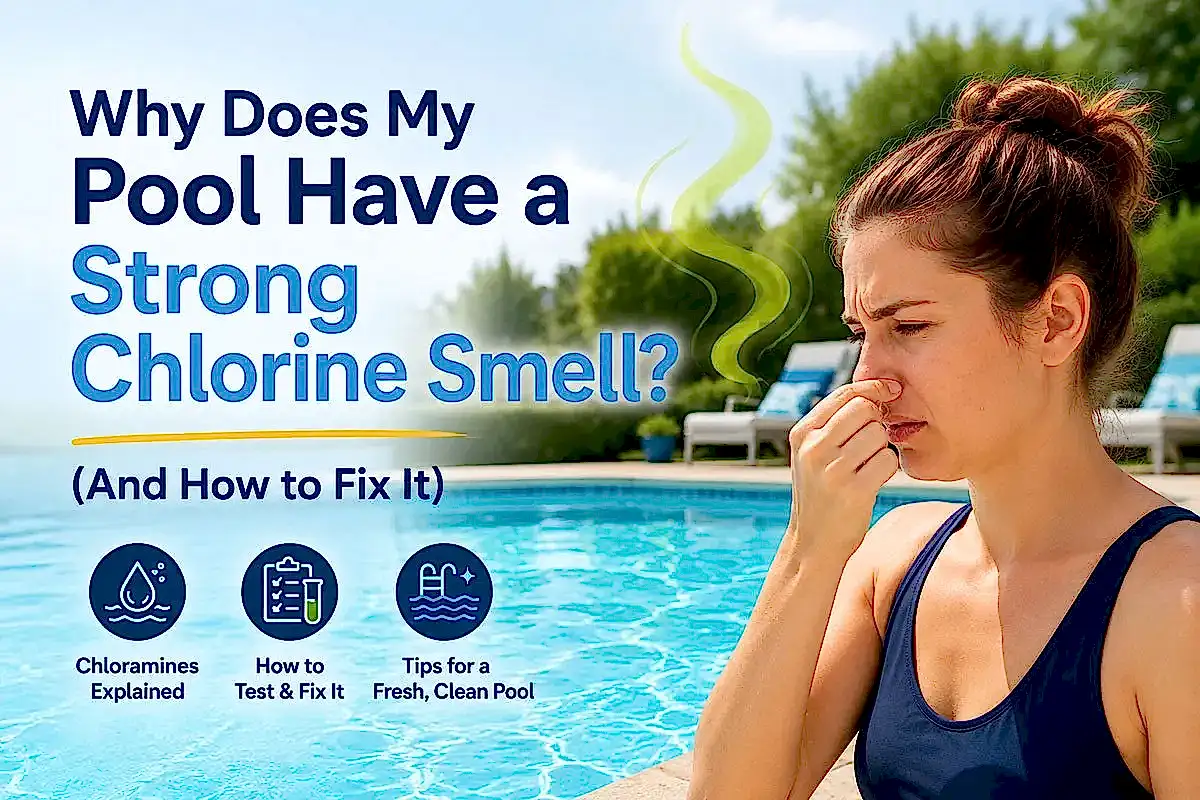
You walk out to your backyard after a hot weekend of pool parties, and are immediately hit by a powerful, pungent chemical odor. Your first instinct is probably to think: “Whoa, there is way too much chlorine in this water.”
It sounds logical, but it is actually a total misconception.
When a swimming pool has a strong “chlorine” smell, it is almost always a sign that the water has too little active chlorine, not too much. That strong scent means your pool chemistry is fighting an uphill battle, and you actually need to add more sanitizer to fix it.
Here is a look at what causes that intense odor, how to test for it, and the exact steps to clear it up so you can get back to swimming safely.
The Short Answer: What is a “Chlorine Smell”?
A strong chlorine smell is caused by chloramines (combined chlorine), which form when active chlorine binds with organic contaminants like sweat, oils and urine. To eliminate the odor, you must add enough fresh shock to reach breakpoint chlorination, which destroys the chloramines and restores the pool’s sanitizing power.
The Chemistry: Free Chlorine vs. Combined Chlorine
To fix the smell, it helps to understand what is happening inside the water. When you test your pool, you are looking at three different figures:
- Free Chlorine (FC): This is the “good” chlorine. It is active, unbound and actively killing bacteria and algae in your pool.
- Combined Chlorine (CC): This is the “spent” chlorine. When Free Chlorine hits organic matter (like sweat, body oils, cosmetics, or urine), it binds to it. These bound molecules are called chloramines.
- Total Chlorine (TC): This is simply the sum of both numbers (FC + CC = TC).
Chloramines are the true culprit behind the smell. Clean, perfectly balanced pool water with healthy levels of Free Chlorine has virtually no odor at all. When chloramines build up, they gas off into the air, creating that strong, irritating chemical scent that burns your eyes and skin.
How to Test Your Pool for Chloramines
Before you add any chemicals, you need to know exactly how high your chloramine level is. You can find this using a standard liquid test kit or high-quality test strips.
| Metric | Target Level | What It Means |
| Free Chlorine (FC) | 1.0 – 3.0 ppm | Active, healthy sanitizer level. |
| Combined Chlorine (CC) | Less than 0.2 ppm | Anything higher causes odor and irritation. |
How to Eliminate Chloramines and Clear the Odor
To get rid of the smell, you have to break the chemical bond of the chloramines. This requires a process called breakpoint chlorination, which means raising your Free Chlorine level to roughly 10 times the amount of your Combined Chlorine.
Follow this sequence to safely clear the odor and reset your water chemistry:
1.Test and adjust your pH:
Chlorine is highly sensitive to pH. Before shocking, ensure your pH is between 7.2 and 7.4. If your pH is too high, the shock you add won’t be strong enough to break down the chloramines efficiently.
2.Calculate your shock dosage:
Find your Combined Chlorine (CC) level. You need to raise your Free Chlorine level to 10 times that CC amount to achieve breakpoint chlorination. Check your pool shock packaging to determine how many bags or gallons are required for your total pool volume.
3.Apply the pool shock at night:
Dissolve your pool shock (calcium hypochlorite or liquid chlorine) according to the product instructions and pour it around the edges of the deep end. Always shock after the sun goes down, as UV rays quickly burn off un-stabilized chlorine before it can finish destroying the chloramines.
4.Run the filtration system:
Keep your pool pump and filter running on high for at least 12 to 24 hours after shocking. This ensures the chemical shock is evenly distributed and helps vent the gassing-off chloramines out of the water.
When is it Safe to Swim Again?
Because breakpoint chlorination requires a massive spike in sanitizer levels, you cannot jump right back into the pool.
Wait until your water has circulated completely and re-test the chemistry. It is safe to swim when your Free Chlorine level drops back down between 1.0 and 4.0 ppm and your Combined Chlorine reads below 0.2 ppm. The strong smell should be completely gone, leaving you with crisp, clean, odorless water.